Most afternoons at Dragon Gym look the same.
Shoes pile up near the mat. Backpacks land against the wall. A group of five year olds lines up, some excited, some quiet, some still gripping their parent’s hand a little tighter than they want to admit.
Parents usually watch from the edge of the floor.
You can tell who is nervous. You can tell who is hoping this helps with focus. You can tell who is worried their child might quit if it feels hard.
And almost every parent wonders the same thing.
Is five too young for karate?
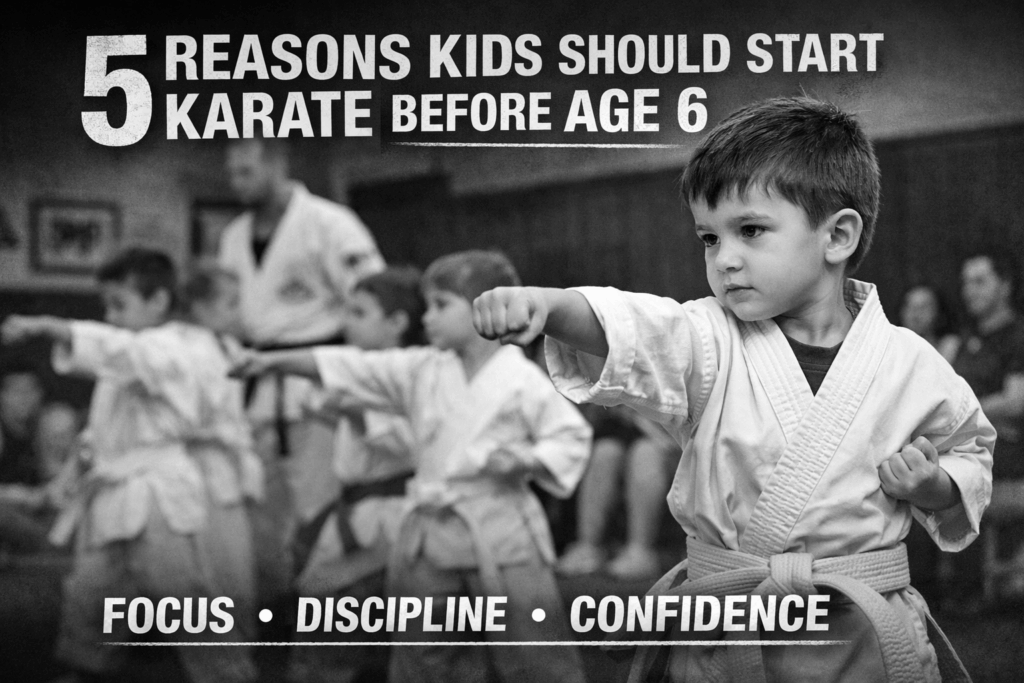
That question shows up weekly from families in Phoenixville, Collegeville, and across Chester County. It is a fair question. At that age, kids still struggle with attention. Emotions change fast. Confidence looks fragile.
Here is the part most parents do not expect.
Starting martial arts before age six is not about learning punches or kicks early. It is about building the internal systems that shape how your child handles effort, discomfort, correction, and commitment.
Those systems form early. Much earlier than most people realize.
Why parents often wait too long
Many parents assume martial arts works best once kids are older.
They think their child needs more maturity first. More focus. More discipline. More confidence.
That logic feels reasonable. It also gets the sequence backward.
Confidence does not appear first. Competence does.
Competence comes from effort and structured practice. That practice must begin while the brain is still wiring habits around behavior, attention, and emotional regulation.
By age six, children are already forming patterns around quitting, avoiding discomfort, and relying on external motivation.
Karate, when taught correctly, interrupts those patterns early.
That is why our children’s martial arts program is structured the way it is at Dragon Gym. It is not designed to rush kids. It is designed to build foundations before poor habits take root.
You can see how we approach this inside our Phoenixville location here
https://www.dragongym.com/offices/martial-arts-classes-in-phoenixville-pa-tae-kwon-do-brazilian-jiu-jitsu.cfm
Let’s walk through the five most important reasons kids benefit from starting karate before age six.
1. Early karate builds attention before distraction becomes the default
Watch a typical five year old try to focus.
They start strong. Then something moves. Then someone coughs. Then their shoelace feels weird. Then their brain goes somewhere else.
This is not misbehavior. This is neurological development.
At ages four to six, the brain is still learning how to filter information. Attention is trainable at this stage, but only if it is practiced deliberately.
Karate class gives kids a structured environment where focus is practiced in short, achievable bursts.
We do not expect perfect stillness. We train attention through repetition.
Line up. Listen. Try. Reset. Try again.
Over time, something important happens.
Kids begin to recognize when their focus drifts. They learn how to bring it back.
That skill transfers everywhere.
Parents often tell us their child sits longer at dinner. Teachers report better classroom participation. Homework becomes less chaotic.
This is one of the most overlooked kids karate benefits.
Focus does not improve by telling kids to pay attention. It improves by training attention like a muscle.
Martial arts for five year olds creates that training without pressure or lectures.
2. Karate teaches emotional control before emotions run the household
Young kids feel everything intensely.
Excitement spikes fast. Frustration hits hard. Small problems feel enormous.
That emotional volatility is normal. What matters is whether children learn how to regulate it.
Karate introduces emotional structure early.
When a child misses a technique, we do not rescue them. We do not shame them. We guide them to breathe, reset, and try again.
When they feel nervous testing in front of others, we teach them to stand tall anyway.
This is emotional discipline in action.
Not suppression. Regulation.
Kids learn that emotions do not control behavior. They learn that effort continues even when feelings fluctuate.
This is especially important for kids self defense classes, not because of physical protection, but because emotional composure determines how a child reacts under stress.
A child who can regulate emotion thinks clearly. A child who panics does not.
Starting karate early builds calm under pressure before anxiety patterns become ingrained.
3. Discipline becomes a habit instead of a battle
Discipline often becomes a daily struggle at home.
Brush your teeth. Clean your room. Finish your homework.
Parents repeat themselves. Kids resist. Everyone gets frustrated.
Karate discipline for kids works differently.
We do not demand discipline. We build it through consistent structure.
Classes begin the same way. Expectations stay clear. Standards stay stable.
Kids know what happens next.
That predictability creates safety. Safety allows effort.
Over time, discipline stops feeling like something forced by adults. It becomes a familiar rhythm.
Show up. Line up. Try hard. Improve.
This is why martial arts for kids near me searches often come from parents who are tired of constant power struggles.
Discipline taught early becomes internal. Discipline taught later often feels imposed.
By starting before age six, kids accept structure as normal rather than negotiable.
4. Early martial arts teaches effort before talent becomes the excuse
At five years old, talent differences are obvious.
Some kids move easily. Some struggle. Some catch techniques quickly. Others need repetition.
What matters is not who learns fastest. What matters is what kids believe learning should feel like.
Karate teaches effort first.
Every child bows in. Every child practices. Every child struggles at some point.
We praise effort. We reinforce consistency. We correct technique calmly.
Kids begin to understand something powerful.
Progress comes from showing up.
This belief matters far beyond martial arts.
When kids learn early that effort creates competence, they stop relying on motivation. They stop labeling themselves as good or bad at things.
They become process focused.
That mindset supports academics, sports, relationships, and long term goal setting.
It aligns directly with the Black Belt system we teach.
A black belt is not a short term goal. It is a long term system built on attendance, effort, and patience.
Children who start early internalize this system naturally.
You can read more about how we approach confidence building in our Phoenixville kids program here
https://www.dragongym.com/blog/kids-martial-arts-in-phoenixville-pa-building-confidence-through-karate-classes.cfm
5. Consistency matters more than intensity at young ages
Parents often worry about overloading young kids.
They imagine long classes or strict training.
That is not how effective kids martial arts classes work.
Consistency beats intensity every time.
Two or three classes per week, done regularly, shapes behavior far more than occasional bursts of activity.
Kids learn to commit to something that extends beyond mood.
Some days they feel excited. Some days they feel tired. They show up anyway.
This teaches one of the most important life skills possible.
You do not quit when something feels uncomfortable.
Letting kids quit during discomfort teaches the wrong lesson. It teaches avoidance.
Martial arts offers a safe environment to practice perseverance in small, manageable ways.
Before age six, kids are highly receptive to routine. Once routines form, they become part of identity.
I am someone who trains.
That identity matters.
Why Dragon Gym starts children early
Our children’s martial arts program across Chester County is intentionally designed for early development.
We focus on:
• Clear structure
• Short focused drills
• Repetition without pressure
• Calm correction
• Consistent expectations
This approach supports kids ages five through fourteen while still meeting parents where they are.
We teach Taekwondo, Brazilian Jiu Jitsu, and foundational movement skills because each discipline reinforces different developmental needs.
You can explore the full children’s martial arts program here
https://www.dragongym.com/practice_areas/children-s-martial-arts-classes-in-chester-county-pa.cfm
Parents often expect martial arts to build confidence first.
What actually happens is deeper.
Kids develop competence through structured practice. Confidence follows naturally.
That sequence matters.
What this means for school readiness
Many families search for an after school karate program because school already feels overwhelming.
Attention demands increase. Social pressure rises. Emotional regulation becomes more important.
Karate supports school readiness in practical ways.
Kids practice listening without constant reminders. They follow multi step instructions. They learn respectful communication.
These skills support classroom behavior without relying on punishment or reward charts.
Teachers notice the difference.
Not because kids become quieter, but because they become more self directed.
That is a major advantage when children begin formal schooling.
Karate as a system for long term development
Parents often think in short windows.
This semester. This school year. This activity.
Martial arts works best when viewed as a system.
The black belt path provides a long term framework for growth.
Kids set goals. They work toward them steadily. They experience setbacks. They recover. They continue.
That system mirrors adult success patterns.
Goals matter. Systems matter more.
Children exposed to systems based goal setting early tend to apply it everywhere.
Homework. Sports. Music. Life.
That is why martial arts is not an activity in our gyms. It is a structure.
Social development without chaos
At five years old, social skills are still forming.
Kids interrupt. They struggle with boundaries. They react emotionally.
Karate teaches social awareness in real time.
Kids take turns. They wait. They encourage teammates. They learn appropriate physical contact.
Unlike free play environments, martial arts provides rules that guide interaction.
Those rules help kids feel safe socially.
This is especially helpful for children who struggle in group settings.
They learn how to belong without needing to dominate or withdraw.
Parents often notice improved peer relationships within months.
Physical literacy before specialization
Early childhood should focus on movement variety, not specialization.
Karate develops balance, coordination, spatial awareness, and body control.
These skills support all sports later.
Kids who develop physical literacy early tend to avoid injury and adapt faster when trying new activities.
Martial arts for kids near me searches often come from parents who want their child active without pressure to compete.
Karate offers physical development without comparison.
Each child progresses individually.
Safety and structure matter
Parents understandably worry about safety.
Our kids programs focus on control, awareness, and respect.
There is no uncontrolled contact. Techniques are taught gradually.
Kids learn how to fall safely, move safely, and interact respectfully.
This foundation supports kids self defense classes later as they mature.
Safety is not only physical. It is emotional.
Kids feel supported. Corrected calmly. Encouraged consistently.
That environment matters deeply at young ages.
Beyond class time
Martial arts does not stop at the mat.
Parents often report changes at home.
Better morning routines. Improved bedtime behavior. Increased responsibility.
These outcomes happen because structure carries over.
Kids recognize expectations. They understand follow through.
Martial arts reinforces what parents already want to teach.
It provides a shared language around effort, responsibility, and respect.
Community matters
Dragon Gym serves families throughout Phoenixville, Collegeville, and surrounding areas.
Our gyms are communities built around long term development.
Kids train alongside peers. Parents build relationships. Families support one another.
This matters more than most people realize.
Children develop identity partly through belonging.
Martial arts birthday parties, karate summer camp, and family events reinforce that sense of connection.
Kids feel part of something consistent.
That consistency supports emotional security.
What parents often say after starting early
We hear similar feedback repeatedly.
I wish we started sooner.
I did not expect this much improvement.
This structure helps at home.
Not because karate fixes kids, but because it gives them a framework.
Kids want structure even when they resist it.
Early martial arts provides that structure in a positive way.
A calm perspective for parents
If your child is five, you do not need perfection.
You do not need focus all the time. You do not need flawless behavior.
You need consistency.
You need an environment that rewards effort and patience.
You need a system that teaches growth over time.
That is what karate provides when started early.
This is why we do things the way we do at Dragon Gym.
We are not rushing kids.
We are building foundations.
Keep showing up. Stay consistent. Trust the process.
That is how confidence forms.
That is how competence grows.
And that is how children become capable, resilient, and steady as they grow.
Parents who understand this know they are in the right place.